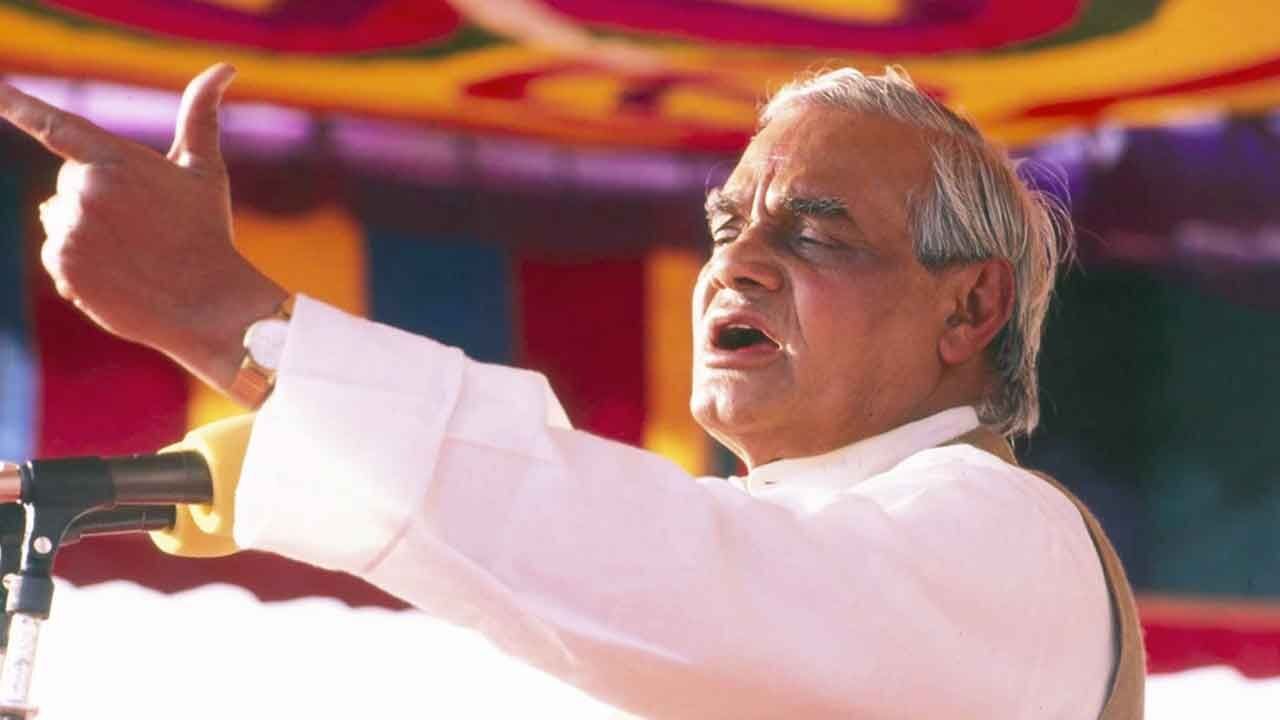
Atal Bihari Vajpayee will always be remembered as an astute leader who upheld democratic traditions and values, a great administrator, and most of all, a good human being. He connected effortlessly with both young and old. His oratory skills, poetic flair, wit and humour made him a “must hear” speaker—you’d want to listen to him at least once in a lifetime. I was one of the lucky few who heard him not once, but three times. Even after so many years, his words still echo in my ears. His powerful speeches left an indelible mark on every audience.
It was the year 1961, I was only 10, when my father, one evening, told me to be ready by 5p.m.—we had to reach Goshamahal Grounds, to hear this great man. From a young age I was fascinated by political speeches; I didn’t even know who Vajpayee ji was then. My father was a huge admirer and never missed his meetings. I always tagged along. By the time we got to the sprawling ground, the stadium was almost full.
People were buzzing with anticipation. He arrived almost on time- unlike present day politicians who wait for the crowd to swell. As a Hyderabadi girl, I struggled with his chaste Hindi that flowed like calm water, but I was completely taken over by his oratory and the way he connected with the crowd. From that moment I became a huge fan and follower. His speeches at Charminar, Gulzar Houz, Nizam College grounds, Fateh Maidan (present day Lal Bahadur Stadium) – venues too small for the surging crowds-remain unforgettable.
The second time I heard him was in 1969 during the separate Telangana movement, when he supported the demand for a separate state. We sat in awe, jaws dropped, marvelling at how he kept the audience spell-bound. This time I was seated right in front. I was part of the student movement, even on a hunger strike. He praised the girls and promised full support. Amid the peak agitation he warned students against violence, reminding us that it would derail our goals and bring harsh repercussions. He advised us to be always target orientedand hit the Bull’s eye.His strong, loud voice, with its unmistakable style, reverberated through every lane of Hyderabad.
His fiery, powerful speeches after Emergency were also worth listening to. Even his opponents sometimes attended his meetings just for the sheer oratory. As Foreign Minister Vajpayee became the first person in 1977 to deliver a speech at the United Nations General Assembly in Hindi.
In 1994 Atal Bihari Vajpayee was appointed by then Prime Minister P.V. Narasimha Rao to lead India’s delegation at United Nations Human Rights Commission (UNHRC) in Geneva in 1994 to counter Pakistan’s propaganda on Kashmir, demonstrating a rare instance of bipartisan unity on National Interest by putting a respected opposition figure in-charge of a crucial diplomatic mission. The Prime Minister chose Vajpayee to send a clear message to the world that on matters of National Sovereignty; politicaldifferences take a back seat.
Vajpayee’s role in the 1998 Pokhran nuclear tests (Operation Shakti) was decisive, as Prime Minister, he green lit the secret tests, demonstrating Indian Nuclear capability and self- reliance, managing intense international pressure and establishing National Technology Day to honour scientists like Dr. Abdul Kalam who made it happen, solidifying India as a nuclear power. The “People’s President Dr. Kalam was his ‘gift’ to the people of this country.
I was lucky enough to meet Prime Minister Vajpayee in 2001 at a DRDO Scientists Award function in Vigyan Bhavan. During lunch time I managed to meet him and wish him because my husband was one of the awardees. I mentioned my attendance at his 1969 Telangana Movement public meeting. He quipped in Hindi, “the then college student is here”. I was thrilled, almost speechless- it felt like a dream come true, a boon and a memory I will cherish forever.
Vajpayee had a close connect with Hyderabad. During, his political career, especially in his years in the opposition, he frequently addressed public meetings across Hyderabad and Secunderabad. People of that era recall his affinity to the city, his love for the local food and his particular love for the sweets from ‘G Pulla Reddy Sweets’. He used to address Pulla Reddy as Mithai Reddy, such was his attachment to the brand.
Many a times Vajpayee said that his poetry is a declaration of war, not an exordium to defeat. It is not the defeated soldier’s drumbeat of despair, but the fighting warrior’s will to win. It is not the dispirited voice of dejection but the slurring shouting of victory.
Vajpayee’s legacy is frequently discussed in the context of India’s evolving civilisational politics.
Commentators argue that he broadened the appeal of cultural nationalism by combining it with consensual politics, parliamentary decorum and a commitment to democratic institution. His rhetoric style and poetry continue to be cited as expression of a vision of India that integrates modern governance with cultural self- awareness.