

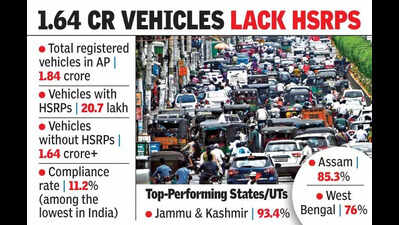
Vijayawada: The nationwide initiative to affix tamper-proof high-security registration plates (HSRP) on vehicles has revealed stark disparities across states, with Andhra Pradesh emerging among the lowest in compliance. Despite their introduction to curb vehicle theft, duplication, and misuse, nearly 89% of registered vehicles in Andhra Pradesh are yet to switch to HSRPs, according to data from the ministry of road transport and highways.As of August 12, Andhra Pradesh had 1.84 crore registered vehicles, but only about 20.7 lakh vehicles had HSRPs affixed, leaving more than 1.64 crore vehicles non-compliant. This translates to a compliance rate of just 11.2%, one of the poorest in the country.Across India, 40.07 crore vehicles are registered, out of which 20.16 crore have been fitted with HSRPs, bringing overall compliance to just under 50%. States such as Jammu & Kashmir (93.4% compliance), Assam (85.3%), and West Bengal (76%) have fared much better, while union territories like Lakshadweep (2.4%) and states like Kerala (25.5%) continue to lag.Neighboring states reflect a mixed picture: Karnataka has fitted HSRPs on 1.42 crore vehicles (42.3%), while Tamil Nadu lags at just 31.3% compliance. In contrast, Odisha (66.4%) and West Bengal (76%) have made significant progress, showing the gap in southern states compared to parts of eastern India.HSRPs, mandated under Rule 50 of the Central Motor Vehicle Rules, 1989, are made of tamper-proof 1 mm aluminum plates with rounded edges and an embossed border. Each plate carries a chromium-based hologram, a laser-etched 10-digit identification number, and a non-removable snap-lock fitting system. These features make them difficult to counterfeit, enabling easier vehicle identification and reducing crimes such as theft and cloning of number plates.The plates are also digitally linked with the VAHAN national database, allowing law enforcement agencies to verify vehicle details in real time, improving both road safety enforcement and crime detection.The Centre has issued multiple advisories to state transport departments and manufacturers to crack down on illegal suppliers. Distribution bottlenecks, particularly in rural and semi-urban areas, have further slowed down adoption.Another challenge lies in the pricing disparity. While the Centre frames the rules, it is up to state transport authorities and manufacturers to handle implementation. On the other hand, there is a combination of logistical delays, inadequate vendor networks, and a lack of awareness among vehicle owners.The state govt has been under pressure to ramp up distribution channels and widen access through more authorised dealers. Efforts are also underway to integrate awareness campaigns with routine vehicle checks, such as fitness certificate renewals and emissions testing, to accelerate compliance.The ministry of road transport and highways maintains that ensuring universal adoption of HSRPs is essential to strengthening India’s road safety ecosystem. While half of India’s vehicles now carry the new plates, the other half—amounting to nearly 20 crore vehicles—are yet to be covered, posing both administrative and enforcement challenges.For Andhra Pradesh, where the gap is especially large, bridging the compliance divide will be critical not only to align with national road safety goals but also to reduce the risks of vehicle-related crimes that tamper-proof plates are designed to prevent.