
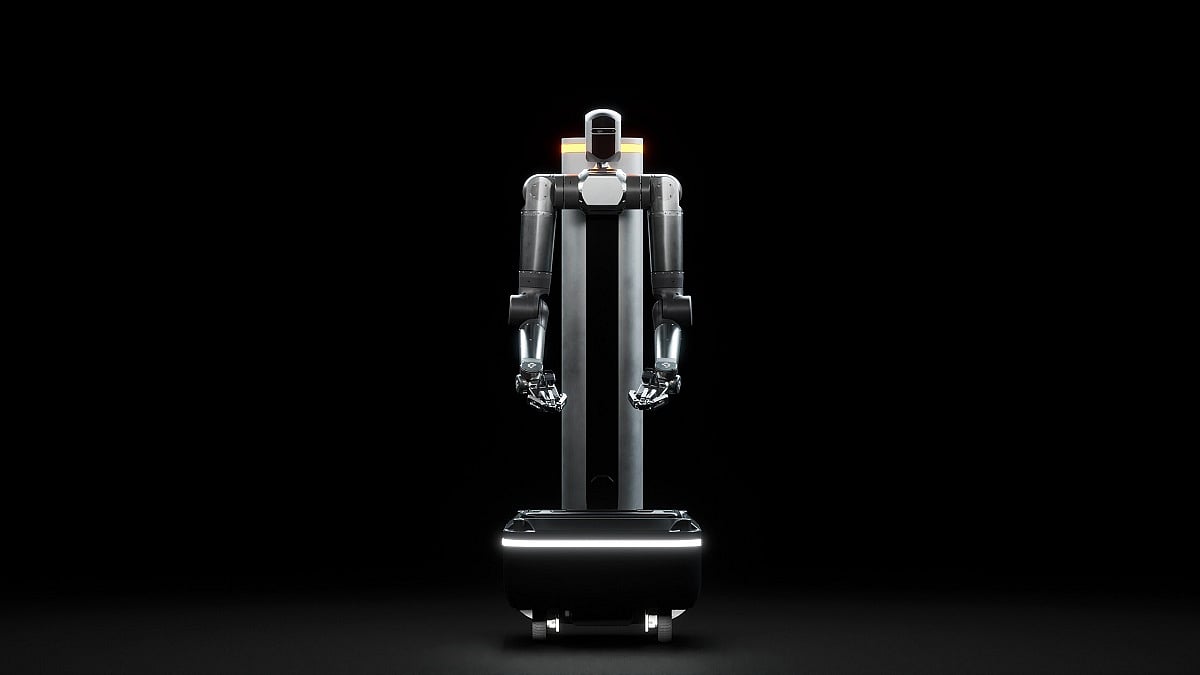
Perceptyne Robots, founded in Hyderabad by Raviteja Chivukula, Jagga Raju Nadimpalli, and Mrutyunjaya Nadiminti, is redefining India’s automation landscape by building intelligent, homegrown robots aimed at rivalling Chinese counterparts. Powered by indigenous R&D and AI-driven engineering, their solutions help EMS and automotive clients cut costs by up to 40 percent. Their humanoid robot PR-34D was shortlisted for the Humanoid Robotics Industry Awards 2025 under ‘Groundbreaking Technology’, alongside global giants. CE speaks to co-founder Jagga Raju about this journey.
Excerpts
What was the moment you realised that dexterous, human-like robots right here in India could be engineered?
Our conviction didn’t arrive in a single moment, it grew from three directions, one from each co-founder. Each of us had a turning point when the dream felt possible, and coincidentally, we all called each other around the same time with that thought. For Ravi, our CEO, it began almost a decade ago while building a kiosk where each new SKU required heavy engineering — unlike a human, who picks instantly. Advances in compute, AI, and miniature actuators by 2022 made human-like robotics feasible, reinforced by global proof points. My conviction came from autonomous vehicle experience, and Mrutyunjaya’s from using robotics as a teaching platform and usability insights.
How would you sum up the emotional and technical journey from your first prototype to being shortlisted alongside global giants?
We’ve always been early movers, spotting humanoid robotics’ potential before the space crowded. In 2022, Boston Dynamics was the only major player, Tesla had just announced Optimus, and China was yet to enter. That year, we wrote a white paper on humanoid robots and core technologies, committing to build every critical component ourselves. Off-the-shelf parts are costly; a viable humanoid needs ground-up engineering of actuators, sensors, and control. Today, we have full sensory capability and integrated closed-loop control. Being shortlisted alongside
NVIDIA and Agibot by the Humanoid Robotics Technology platform validated our unique IP and India-based effort.
What inspired you to build world-class robotics in India?
India imported about 4,500 robots in 2022 and nearly 9,000 in 2024 — none manufactured locally. This gap led us to ask why domestic production didn’t exist, and the answer was clear: without local production, the supply chain never matures. Globally, it’s the opposite — half the world’s robots are consumed in China, where German, Japanese, Korean, and Swedish companies manufacture precision, position-driven robots with ultra-expensive components. New-age robotics, however, is about intelligence and adaptability. Simply importing components would make robots prohibitively expensive for Indian industries. The only viable path was to engineer everything from the ground up like actuators, drives, gearboxes, control architecture — using intelligent feedback systems to cut costs without compromising capability. Strategically, by 2022, the China-plus-one trend was underway, and India, as a trusted democracy, was well-positioned to become an alternative. Building a robotics company with an India-centric supply chain was therefore not only patriotic but smart business. For both economic and strategic reasons, creating scalable, affordable, world-class robots from scratch in India was the only meaningful approach.
What makes the PR-34D humanoid truly revolutionary in its dexterity, adaptability, and intelligence?
The ‘groundbreaking technology’ recognition for PR-34D comes from its core innovation: integrated force–torque and high-resolution tactile sensing. Unlike traditional robots, which rely on joint angles and costly add-ons, PR-34D’s sensors are engineered in-house, offering 2mm × 2mm resolution across the entire hand with torque sensing at every joint and seven degrees of freedom. Globally, no platform combines this capability at an accessible price. PR-34D enables serious manipulation work, mimicking human dexterity far beyond most costly humanoid or limited Chinese robots.
What’s the toughest part of teaching a robot to move, react, and adapt the way humans do?
There are two layers to this: hardware and intelligence. On the hardware side, a human arm has seven degrees of freedom, packed into extremely compact joints. Replicating that structure in a robot — with actuators, sensors, wiring, and mechanics all fitting into tight spaces — was our first major challenge. The bigger challenge is intelligence. We’ve built the hardware; now we’re building the software that gives it true dexterity. This happens through teleoperation: a human mirrors the robot’s arm while performing actions like picking a bottle or folding cloth. An AI layer records angles, vision, force, grip changes and more, learning patterns and eventually executing tasks autonomously. This end-to-end learning is the foundation of modern physical AI.
How do you see robots enhancing human potential rather than replacing jobs?
Before the Industrial Revolution, most people worked on farms. As technology reduced manual farm labour, society gradually shifted to industrial and knowledge roles. When computers arrived in India, many feared clerks would lose jobs, yet computers ultimately boosted productivity and created more meaningful work. Every major technological leap brings temporary disruption — some reskill, some face uncertainty — but historically societies adjust upward. Today the concern isn’t robots replacing people; it’s a global shortage of people willing to do basic repetitive industrial tasks. With countries reshoring manufacturing and labour becoming scarce and expensive, automation is no longer optional. Without it, essential products would be unaffordable. For many industries, automation is a lifeline, driving long-term growth and competitiveness for the future.
What gives Indian robotics innovators an edge against Chinese imports?
Competing with China on cost alone is tough — they benefit from government support and massive early-scale manufacturing. But customers buy solutions, not just hardware. Success depends on understanding problems, engineering the right hardware-software solution, and providing end-to-end support. India’s edge lies in deep problem insight, solution engineering, and agility. We’re building for the world, innovating from first principles: designing robots that are easier to manufacture, more reliable, and cheaper to maintain. With three years of in-house capability and the global ‘China-plus-one’ trend, high-quality, cost-competitive solutions make clients eager to choose us.
How will Make in India shape India’s robotics landscape?
Make in India has been pivotal in defence and electronics. The PLI scheme, especially in semiconductors and electronics, has been a big success. It’s all pushing companies to innovate and manufacture locally. Robotics, however, is still early. India is yet to see a company building industrial robots fully in-house. Most global brands manufacture outside India. It will take time for the ecosystem, supply chains, and capabilities to mature enough for a noticeable impact. We’re still at the beginning of that journey.
How do you show investors that world-class innovation can be built in Hyderabad?
In the early stages, proving your concept is challenging — you often need resources before you can demonstrate results. Early fundraising is as much about storytelling, credibility, and conviction as it is about the idea itself. We began extremely small, with the three co-founders working out of a 2bhk, one bedroom doubling as our office, before moving into a friend’s startup cabin. Government support like the NIDHI-PRAYAS grant and Startup India Seed Fund, along with Hyderabad’s robust ecosystem — T-Hub, CIE at IIIT Hyderabad, T-Works — were crucial. Our prior experience built investor trust, and a $500,000 seed from family, friends, and early believers helped us build a functional prototype. That prototype unlocked larger funding, enabling us to hire, scale, and expand our product portfolio.
What’s the roadmap ahead?
We’re launching a new website showcasing our full product portfolio. Over three years, we’ve built core technologies in-house and are now productising them: PR Omni, a mobile humanoid on a 4WD AMR; PR Duo, dual-arm fixed robots; PR Uno, single-arm systems; and PR Sapien, a bipedal humanoid for homes and uneven terrain. All platforms are powered by specialised software, turning hardware into task-specific intelligence. Different software modules will eventually combine to handle increasingly complex workflows.