

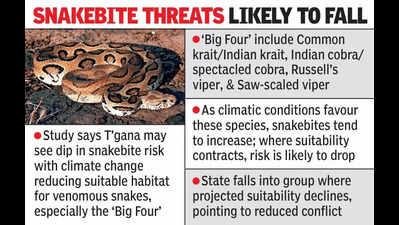
Hyderabad: Telangana may see a dip in snakebite risk as climate change steadily reduces suitable habitat for the ‘Big Four’ venomous snakes, even as many other parts of India move towards higher risk, a new study in Nature Scientific Reports found. The work, led by Ashish Kumar Jangid of the Wildlife Institute of India, Dehradun, shows that Telangana sits within a belt where climate-driven suitability for these species consistently declines across future scenarios, pointing to fewer human–snake encounters in the decades ahead.The study reports that while warming and shifting rainfall patterns are driving snake-friendly conditions in several regions, some areas are projected to become less favourable for the ‘Big Four’ snakes — Common krait/Indian krait, Indian cobra/spectacled cobra, Russell’s viper, and Saw-scaled viper. Telangana stands out as part of a zone where habitat suitability for these snakes declines across climate pathways, unlike many other states where risk is projected to rise. This decline is significant because the researchers found a clear statistical link between habitat suitability and recorded snakebites. A ‘consensus’ suitability index for the ‘Big Four’ showed a strong positive effect on state-wide snakebite records. In other words, as climatic conditions favour these species, snakebites tend to increase; where suitability contracts, the risk is likely to drop.Future scenarios in the study indicate rising snakebite risk in parts of northern India, including the Himalaya and northeast India, and in elevated southern ranges such as the Western Ghats. Telangana, by contrast, falls into the group of states where projected suitability declines, pointing to reduced conflict even as risk is redistributed elsewhere.To capture how climate change could reshape venomous snake distributions, the team first pulled together a preliminary checklist of 44 terrestrial venomous species—19 from the family Elapidae and 25 from Viperidae—using peer-reviewed literature, biodiversity portals, and verified citizen science datasets. From this list, 30 terrestrial venomous species were included in the climatic suitability analysis: 16 Elapidae and 14 Viperidae. Species with fewer than 10 occurrence records were excluded to avoid weak predictions.The final dataset comprised 4,966 occurrence records drawn from citizen science platforms, open repositories, social media groups, and scientific literature, which were then ‘thinned’ at a 1 km² scale to 2,931 unique locations. The modelling was done against the backdrop of India’s climatic and habitat diversity. The authors frame their analysis within nine biogeographic zones—Trans-Himalaya, Himalaya, Semi-arid, Gangetic plain, Deccan peninsula, Desert, Northeast, Western Ghats, and Coasts—and four global biodiversity hotspots present in India: Himalaya, Indo-Burma, Western Ghats, and Sundaland.Under the 2070 scenario, considering all 30 species together, the analysis revealed a net gain of about 47,000 km² (colonisation) and a net loss of around 48,500 km² (extinction) of hotspot areas—a turnover of 23.88%, affecting roughly 2.66% of India’s landmass. Only 72.93% of current hotspots persisted to 2070 in this worst-case scenario.