
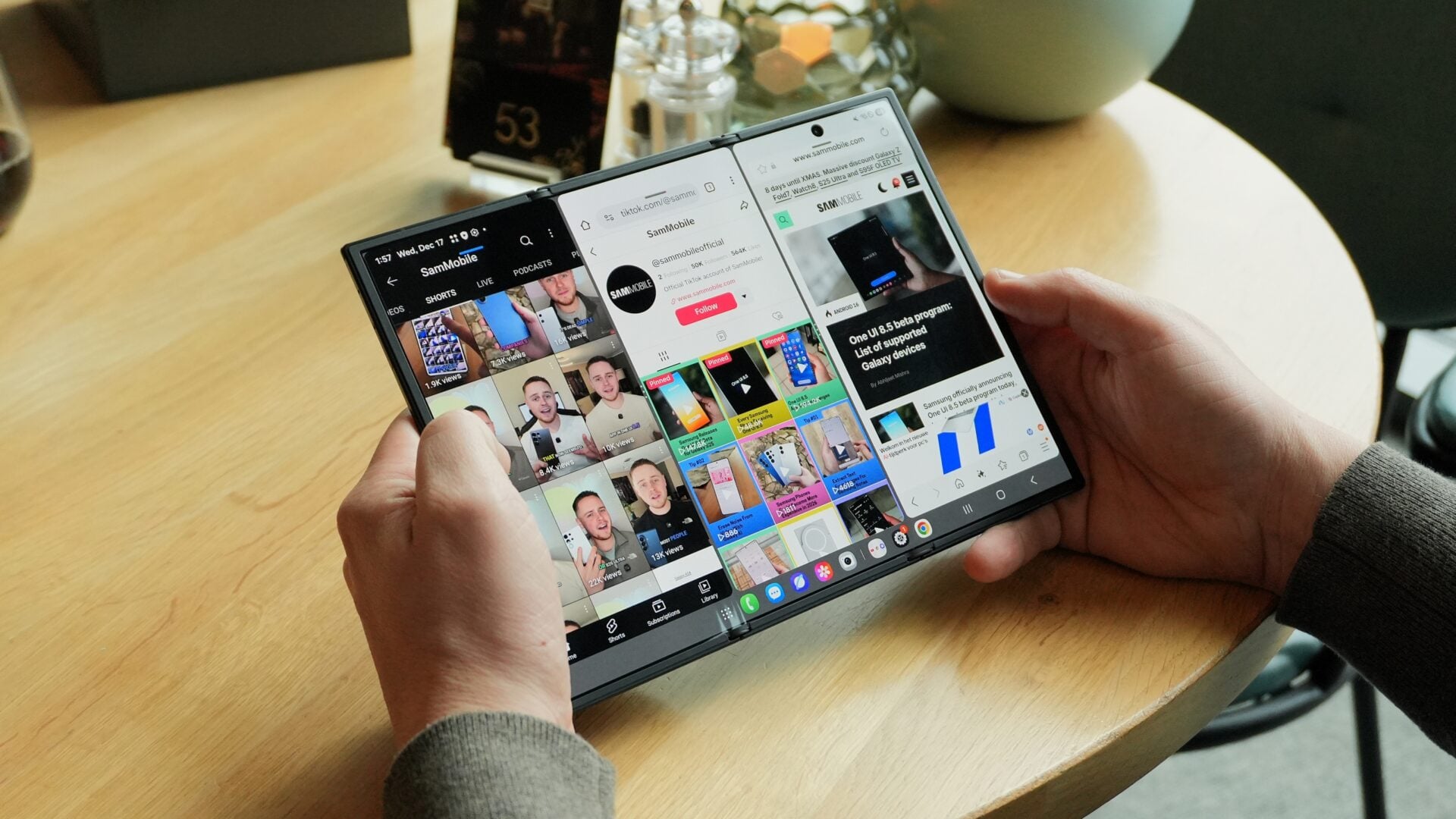
Samsung really wants its foldables to be thin. Every new Galaxy Z Fold is marketed around being slimmer than the last one, and the Galaxy Z TriFold breaks thinness records even as a first-gen product. And while that looks good on paper, it’s starting to hurt the actual experience in ways that are hard to ignore.
Speaker quality is one of the biggest problems
For years, Samsung’s Fold phones had excellent speakers. They were different from other Galaxy phones because they used two dedicated speakers instead of using the earpiece as one of them. That made a real difference. Up until the Galaxy Z Fold 5, audio quality was genuinely great, with good volume and noticeable bass.
The Galaxy Z Fold 6 lost a bit of bass, but it was still solid. The Galaxy Z Fold 7, though, is a big step back. Most of the bass is gone. When you compare it to the Galaxy S25 Ultra, which still uses the earpiece and a single dedicated speaker, the cheaper phone actually sounds fuller and punchier.
This isn’t really surprising. Speakers need space, especially for bass. The thinner a phone gets, the less room there is for proper speaker chambers. At some point, no amount of tuning can fix that. Physics gets in the way.
What’s more disappointing is that Samsung hasn’t fixed this even on the new TriFold. The Galaxy Z TriFold is basically a small tablet when opened, with a 10-inch screen. Samsung’s tablets usually have four speakers and sound great. But the TriFold doesn’t. In our experience, it’s got the same puny speakers as the Fold 7. Samsung could have added more speakers, but it didn’t.

The TriFold’s tablet-sized display is paired with puny speakers
At the same time, Samsung keeps charging more. The Galaxy Z Fold 5 launched at $1,799. The Fold 6 went up to $1,899. The Fold 7 costs $1,999. And yet, things are being taken away. The Fold 7 doesn’t support the S Pen anymore (neither does the TriFold). Speaker quality is worse. These are real downgrades, not minor trade-offs.
Cameras and battery aren’t immune either
Thinness has also affected the cameras. The Fold 7 and the TriFold still only have a 3x zoom camera, the same setup Samsung has used since the Galaxy Z Fold 3. Even the $699 Galaxy S25 has a 3x zoom camera, and the S24 Ultra and S25 Ultra have both 3x and 5x dedicated cameras.
Battery capacity tells a similar story. The Galaxy Z Fold 7 uses the same battery size as the Fold 3, Fold 4, Fold 5, Fold 6, and Fold Special Edition. And with how thin the phone now is, it feels like Samsung has run out of physical space to increase it at all. For devices that are supposed to replace both a phone and a tablet, that’s a pretty big limitation.
If Samsung keeps chasing thinness, these kinds of compromises are only going to get worse. There’s a limit to how much you can slim down a device before it starts hurting the basics or stops you from bringing meaningful upgrades. Worse speakers, no S Pen support, same old camera setup, and small batteries aren’t minor issues on phones costing $2000 and more.
At such prices, a foldable shouldn’t feel like it’s cutting corners. If being thin matters more to Samsung than fixing these problems, then its foldables just aren’t for me. I’d rather use a thicker phone that does everything well than pay more for one that keeps giving up useful features just to be slimmer.