

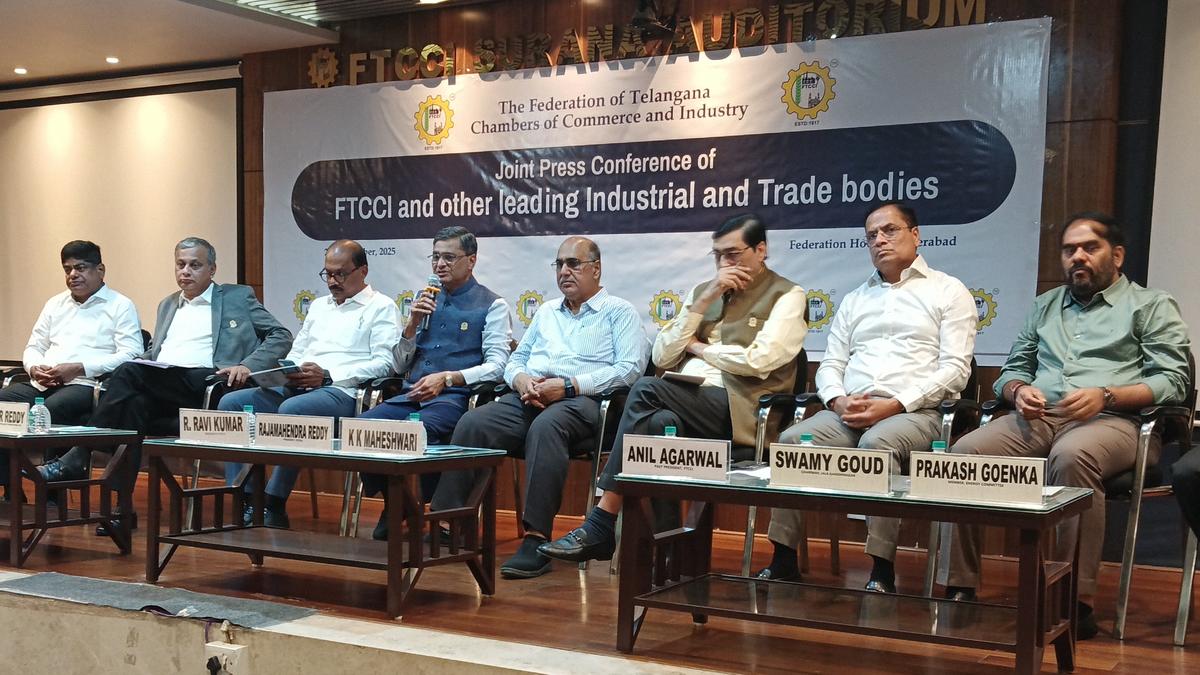
FTCCI president R. Ravikumar with leaders of trade and industry bodies at a media interaction in Hyderabad on Wednesday.
| Photo Credit: N. Ravi Kumar
A clutch of bodies representing thousands of MSMEs in Telangana came together on Wednesday, under the banner of the Federation of Telangana Chambers of Commerce and Industry (FTCCI), and voiced their concerns over the surge in electricity bills following recent changes, including withdrawal of time-of-day (ToD) concession.
The State government should hold wider consultations with stakeholders before rolling out such measures like the Hyderabad Industrial Lands Transformation Policy (HILTP), which seeks to relocate industrial units beyond Outer Ring Road (ORR).
While the increase in power bills has come as a shock and eat into margins, HILTP could threaten existence of units, both continuing at the same place and those resited, the association leaders led by FTCCI president R. Ravikumar sought to highlight.
Apart from FTCCI, representatives of Telangana Industrialists’ Federation, Telangana Iron and Steel Manufacturers’ Association, Federation of Telangana Small Industries’ Associations, Cherlapally Industries’ Association, Industrial Area Local Authority Gandhinagar and Telangana State Solar Open Access Developers’ Association, spoke at the media interaction here.
Stating that electricity bills have shot up 70% to as much as four times, the leaders attributed this to sudden implementation of unblocking of Lead kVArh. DISCOMs have abruptly unblocked lead kVArh billing for commercial and industrial consumers, effectively forcing them to move away from lead power factor conditions in a span of just three months, TSOADA General Secretary Venkat N.N.K and others said.
The industry bodies want sufficient time for transition, along with awareness and technical guidance programmes, and a holistic evaluation by an expert committee. They are demanding either restoration of night ToD concession (of ₹1.50 per unit) or a higher concession on daytime tariff, especially with DISCOMs procuring a significant portion of power from solar sources at relatively lower cost.
Calling for rethink and recalibration of several critical policy and regulatory measures adversely impacting industry, investments and employment, they said HILTP lacks clarity on the relocation support, compensation mechanisms, timelines and the development of alternative industrial ecosystems outside the ORR. Allowing commercial development in industrial estates will over time make it challenging for those unit that remain.
Relocation of units requires years of planning, approvals, infrastructure readiness, especially connectivity, and workforce alignment, FTCCI VP Srinivas Garimella and TIF president K. Sudhir Reddy said, urging government to keep the policy in abeyance and adopt a consultative approach.
Uncertainty and unilateral decisions would come in the way of attracting fresh investments and bolstering investor confidence, the industrial bodies said, pointing out that though the Clean and Green Energy Policy was announced in January 2025, no NOCs have been issued to solar developers. There are also hurdles in open access power procurement, high additional surcharge and wheeling charges, they said.
Published – December 24, 2025 09:01 pm IST