Every January, just after the Sankranthi cheer ebbs, residents of the Czech Colony in Sanathnagar, Hyderabad, brace for an annual test, watching their water taps a little more closely. The borewell serving their 40-flat apartment still runs twice a day, but not for long. Its yield starts thinning, and within a month, there is nothing left to draw. What follows is a familiar routine: they must depend on water tankers, repeatedly checking the HMWS&SB app, tracking a slow crawl up the waiting list.
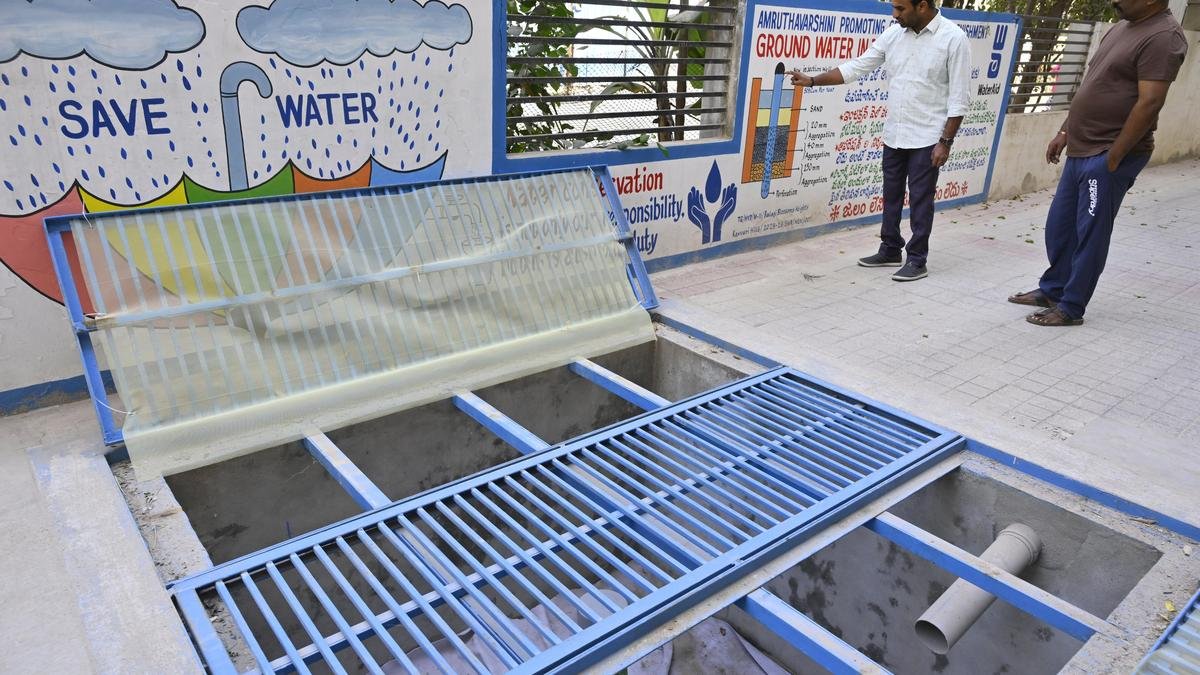
That ritual, however, has quietly ended. T. Srinivas, a member of the apartment association, says the turning point came with the construction of an injection borewell. The change was immediate. “Our borewell improved and a few nearby apartments that opted for percolation pits saw a difference too.”
He details the consultations that went into the project, the pit collection system, annual rainwater estimates and how the intervention eased everyday life in the building.

Experiences such as this are shaping a broader rethink of water use and conservation across Hyderabad. At Kavuri Hills, in the upscale Kakatiya Hills residential colony, a 16-flat apartment complex built on a 1,000-square yard plot also constructed an injection borewell with technical assistance from the Hyderabad Metropolitan Water Supply and Sewerage Board (HMWS&SB) and WaterAid, an NGO facilitating such projects through corporate social responsibility funds in select localities.
Suneel, an IT professional and resident of the apartment, recalls how the building’s mandated rainwater harvesting structure was once ignored. “We were blessed with water. During monsoon, the borewell would overflow, and we would flush excess water out of the cellar through a hose,” he says.
That sense of abundance, however, faded rapidly as construction activity surged in the neighbourhood. Between January and May this year, the apartment complex purchased two 10-kilolitre water tankers a day for the first time, paying about ₹1,000 per load, often with some waiting period. “We got about 100 tankers,” says Suneel, his eyebrows raised.
The response came in the form of a 200-foot injection borewell. Built with a contribution of just ₹20,000 from residents, it has the capacity to harvest around 509 cubic metres, or 5.09 lakh litres, of rainwater annually.
According to HMWS&SB managing director K. Ashok Reddy, building injection borewells and harvesting pits is a key focus area for the Board. He recently grabbed headlines by stating, “If every house has a rainwater harvesting (RWH) pit, the city may not even need Krishna Phase IV for the 5 tmcft additional water supply”.
Yet, success stories like Czech Colony and Kavuri Hills remain exceptions in a city as large as Hyderabad. They offer a glimpse of the possibilities but do not capture the full picture.
A city that cannot hold its rain
Hyderabad receives an annual rainfall of 700-900 mm. But in 2025, it recorded around 1,060 mm between June and December alone, nearly 40% above normal, according to the Telangana State Development Planning Society.
But the city sits on crystalline formations such as granite, gneiss and compact basalt, which have very low permeability. As a result, groundwater storage depends entirely on fractures, joints, and weathered zones within these rocks. Even in a year of excess rainfall, Hyderabad failed to retain much of it. The absence of harvesting pits and collection systems meant runoff rushed into drains, flowed into the Musi river, and eventually discharged into the Krishna river via Nalgonda district.
The result? Growing dependence on water tankers and deep borewells. Hyderabad is now the most groundwater-extracting district in the State. With extraction exceeding 100% of recharge, the city is classified as both ‘over-exploited’ and ‘critical’. The pressure extends to Rangareddy and Medchal-Malkajgiri districts, which together form the contiguous Greater Hyderabad region, as well as neighbouring Yadadri-Bhuvanagiri. By contrast, Telangana as a whole is in a relatively better position, with an annual groundwater recharge of 20.4 billion cubic metres and average extraction of 45.91%, according to the Central Ground Water Board’s Groundwater Resource Assessment 2024.
To understand why only 42,784 residents in Hyderabad, those in households measuring more than 300 sq. metres, frequently book water tankers, HMWS&SB conducted a citywide survey in 2024. It found that 17,382 of these households either lacked an RWH pit or had borewells that had dried up. Others had pits but did not use them. Advisory notices were issued, but compliance remained limited. Broadly, Hyderabad’s water stress can be traced to these tens of thousands of properties, compounded by rapid urban expansion that stretches the Board’s reach.
Parallelly, HMWS&SB launched another survey of borewells installed by the Board and other civic authorities in public offices and community spaces. Eighteen NGOs advocating water conservation were roped in for the exercise. So far, 3,435 surveys have identified 8,285 borewells, of which 4,569 are non-functional. These would now be converted into injection borewells.
Separately, a survey under Jal Sanchay Jan Bhagidari of the Ministry of Jal Shakti, an initiative aimed at constructing one million recharge structures nationwide, began on December 7 this year. Preliminary findings show 7,043 users already have rainwater harvesting structures. These will be linked to the Board’s unique Customer Account Number (CAN). The survey is ongoing.
When water becomes a commodity
If sustainability is a long-term pursuit, tanker supply is an immediate race against time. From February to May, the gap between booking and delivery often determines whether Hyderabad edges towards a water emergency.
The summer of 2024 was a turning point. HMWS&SB expanded its tanker fleet from 604 to 1,000 almost overnight as bookings surged to an average of 2,000 a day. Demand was concentrated in western and north-western growth corridors — Manikonda, Gachibowli, Kondapur, Madhapur, Kukatpally, Jubilee Hills and Banjara Hills.
In April 2024, Principal Secretary (Municipal Administration and Urban Development) M.Dana Kishore acknowledged a sudden drying up of borewells in western Hyderabad and a shortage of tankers, drivers and filling points, while maintaining that the city was not in the grip of a water crisis.
Under the Board’s service level agreement, tankers are to be delivered within 24 hours. But in peak summers, the target was reduced to 12 hours or less, with round-the-clock deliveries. Filling stations and points were expanded, and even tanker-filling designs were improvised such as single filler-to-T-joint pipes that could load two tankers simultaneously. Currently, the Board operates 1,150 tankers, supported by 90 filling stations and 150 filling points across the city.
Data on tanker deliveries between January and July over five years, from 2021 to 2025, shows a steady year-on-year increase, mirroring falling groundwater levels and the pace of Hyderabad’s urban expansion.
The escalation is stark. Peak deliveries in April rose from 85,880 tanker trips in 2021 to 2,90,180 in 2025, an exponential 238% jump. Even January, once considered a relatively stable month, saw a 127% rise, from 52,778 trips in 2021 to 1,19,752 this year.
The contrast is visible year-on-year. Between 2024 and 2025, tanker trips in February and March climbed by a steady 58%. April registered a further 22% increase, marking the highest monthly tanker movement in the Board’s history — 2,90,180 trips — followed by 2,77,415 in June.
The big push
In this context, HMWS&SB’s recent announcement marks a decisive shift in Hyderabad’s groundwater conservation strategy. As part of its 100-day action plan, the Board plans to construct 15,000 RWH pits across Greater Hyderabad, extending up to the Outer Ring Road.
While rainwater harvesting structures are mandated for all houses measuring 200 square yards, the requirement will now be enforced strictly for properties of 300 square yards and above.

A water tanker of the HMWS&SB delivering water to a commercial building in Banjara Hills, Hyderabad, on Thursday.
| Photo Credit:
NAGARA GOPAL
The Board has also secured approval from the School Education Department to build rainwater harvesting structures in 1,200 government school premises across Hyderabad and neighbouring districts.
Reiterating the larger ambition, Mr.Ashok Reddy says the city could do without Krishna Phase IV if it creates 50,000 rainwater harvesting structures over the next three years. “Yes, that’s my slogan. Why should Hyderabad’s water flood into the Musi and Krishna rivers, only to be pumped back into the city,” he argues.
He explains that the proposed project would require an outlay of ₹3,000 crore, with recurring annual operations and maintenance expenses of ₹20 crore. By comparison, investing ₹100 crore in rainwater harvesting structures would be far more efficient and sustainable, and could even help check urban flooding.
A key component of the plan is converting dried-up borewells in public spaces across the city into injection borewells. For the immediate construction of 700 RWH pits, the Board has already floated a tender.
HMWS&SB’s push for rainwater conservation is not new. Over the past decade, it has taken multiple forms, with mixed outcomes. A similar 100-day action plan was rolled out in May 2016, during which 2,200 rainwater harvesting structures were built in common public spaces. The effort, however, fell short over time as resident welfare associations failed to maintain the structures.
This was followed by the launch of Jalabhagyam in 2017 and Jala Jeevam in 2018. These programmes empanelled NGOs to educate residents on rainwater harvesting, maintenance practices and technical aspects. Jala Jeevam went further by making RWH structures mandatory for all households, expanding NGO involvement and constituting an expert committee on rainwater conservation.
Moreover, 1,600 Jalavaarasathvam clubs were formed, involving grandparents and children, along with resident welfare associations and self-help groups, to revive a culture of water conservation. That same year, the Board developed a Rainwater Harvesting Theme Park on Road No. 51 in Jubilee Hills, showcasing around 40 water conservation interventions. The facility remains operational and is free for public use.
Another initiative, Water Leadership and Conservation, was launched in 2019 as a Sanathnagar-specific programme aimed at driving behavioural change and reducing water wastage.
Government policy and intent, however, have not fully translated into active public participation. The data reflects this gap. In 2025, average demand for water tankers rose by 36.37% over 2024, while year-on-year projections estimate a further 22% increase. On rainwater harvesting, the Board continues to issue advisory notices to non-compliant properties under provisions of the Water, Land and Trees (WALTA) Act.
The missing link?
What stands in the way, officials argue, is mindset. “The attitude is: I can pay for water, use influence to get a tanker even in summer, and wash my luxury car with piped water. This is 100% literacy with ignorance and lack of common sense to use a limited resource wisely,” says T. Sharath Reddy, Deputy General Manager (Engineering), HMWS&SB, one of the two senior officers supervising Durgam Cheruvu, a high water tanker-dependent division.
Jala Satyanarayana, Assistant Director (Rainwater Harvesting), HMWS&SB, whose phone number features on notices issued to households without RWH structures, recounts the responses he receives. “Some even threatened me, thinking it was a legal notice. I explain, visit their premises, and help design the structure. They do understand and want to build one. But, in general, people value water only when they experience scarcity.”
For Kalpana Ramesh, designer-environmentalist and founder of The Rainwater Project, the missing piece is community ownership. Even well-crafted policies, she argues, fail without local engagement and upkeep.
“How many can say they collect rainwater and are not contributing to urban flooding? How many would prioritise an RWH pit over interior design? How many speak of duties, not just rights? The key is collective stewardship, where everyone is responsible and collaborative,” she says.
According to officials, where resident welfare associations and NGOs are active, a mix of awareness, community involvement, and what Kalpana Ramesh calls “penalties and harsher action” can act as effective deterrents.
However, social fault lines complicate conservation efforts. In Malkajgiri, V. Sushmitha, a schoolteacher living in a 16-unit apartment complex, points to a common obstacle. “There is a lack of unity among residents,” she says. “Tenants don’t want to get involved, owners live elsewhere and nobody wants to bother. The space meant for RWH gets converted to parking. Any discussion leads to petty quarrels — and personal egos.”
(Names of the residents have been changed to protect privacy)